
By Hunter Bryn
There is a clear shift happening within The United Methodist Church toward a greater understanding of extension ministry. One extension ministry, chaplaincy, is increasingly recognized not as a side ministry but as a vital extension of the church’s witness in the world.
Today, nearly 1,000 United Methodist elders, according to the General Board of Higher Education & Ministry, are endorsed as chaplains, serving in environments as varied as military bases, prisons, hospitals, corporate campuses, and more. Corporate demand for chaplains is also on the rise, with companies like PayPal and Tyson Foods seeking their services to meet the emotional, ethical, and spiritual needs of their employees.
The Formation of a Chaplain
The education and training to become a chaplain is rigorous. Candidates must first earn a bachelor’s degree and a Master of Divinity. Military chaplains often go further, earning a Doctor of Ministry. In addition to theological training, chaplains receive extensive mental health preparation, often working alongside psychologists to sharpen their counseling skills. This allows them to meet people where they are — whether in moments of crisis, transition, or moral conflict.
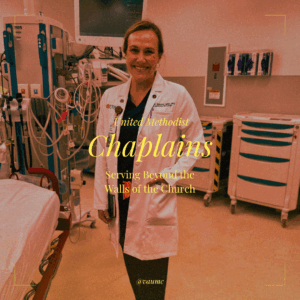
For Rev. Carly Sawyer, MDiv, BCC, staff chaplain for emergency and trauma services at UVA Health, the calling came unexpectedly. “I almost went to medical school,” she explained. “But I felt called to ministry in college. It was distressing because I had planned on being a doctor since I was three.” Sawyer wrestled with her decision but found her way to chaplaincy through a Clinical Pastoral Education (CPE) internship. “I just fell in love with it,” she said. “It felt like everything I had been doing — being a seminary student with a biology degree, wondering still how I ended up here — kind of fell together. It was the perfect intersection of my gifts and my interests. But it was not something that I saw coming.”
The Virginia Conference continues to affirm the importance of CPE. It is one of the few remaining conferences in the Southeastern Jurisdiction that still requires 0.5 units of CPE for full membership and ordination. Leaders believe this requirement provides pastors with invaluable tools: insight into themselves, stronger pastoral care practices, and an ability to see the movement of the Holy Spirit beyond the walls of the church.
Beyond the Misconceptions
Many people assume chaplains are simply pastors in a hospital or military uniform. Sawyer sees this as one of the biggest misconceptions. “One is that we’re all Christian. Another is that all we do is pray with people who are dying. Maybe only 20% of what we do is explicitly religious in nature,” she said.
Instead, she describes chaplains as “spiritual chameleons” who meet people where they are — across all faiths, no faith, or those unsure about faith. “One of the nurses once told a patient, ‘Carly’s just kind of a professional best friend. And sometimes you need that.’ That’s really what it can be.”
A Day in the Life
For Sawyer, each day looks different. She responds to trauma alerts — car accidents, assaults, falls, or cardiac arrests — and provides support to families, patients, and medical staff alike. “As much as I can plan my day, there’s always the possibility that it can go very differently, very quickly,” she said.
She also serves on the hospital’s ethics consult service and regularly teaches in the School of Medicine and School of Nursing. “So much of what I do is crisis management. Sometimes it’s end-of-life care, but often it’s just walking families through the process of stabilization, recovery, or making sense of what’s happening.”
Chaplaincy in the Virginia Conference
The Virginia Conference has 29 clergy serving in extension ministry who are endorsed in chaplaincy. Among them, two serve as military chaplains and 16 serve in hospitals or healthcare facilities. These clergy take the light of Christ beyond the church walls to those who desperately need it.
For those discerning a call, there are robust opportunities for training and support. Wesley Theological Seminary offers a doctorate track in Military Chaplaincy, overseen in part by Rev. Dr. Jim Driscoll. Clergy exploring chaplaincy or other extension ministries can also connect with Rev. Jessie Colwell, Director of Clergy Excellence, or Rev. Dr. Ryan LaRock, chair of the Extension Committee.
The Wider Scope of Chaplaincy
Chaplains serve at some of the highest levels of influence — from Camp David to the White House. Barry Black, Chaplain of the U.S. Senate, is one example of how chaplaincy blends pastoral presence with prophetic witness. Whether guiding Marines on matters of religious liberty or offering counsel in moments of national decision-making, chaplains stand at the intersection of faith and public life.
Sawyer points out that chaplaincy is as varied as the people who pursue it. “There are chaplains who serve in hospitals, yes, but also in the military, in corporations, even on the Appalachian Trail or in national parks,” she said. “There’s a type of chaplaincy for every personality. For me, I’m an adrenaline junkie — I love the science and the medicine. For others, hospice or parish-based care might be the right fit.”
Distinct but Vital Work
Sawyer emphasizes that chaplaincy is a distinct profession, requiring training and certification beyond ordination. “For hospital chaplains, you usually have to be board certified, which means a full year residency, a couple thousand hours of work, and about 100 pages of writing that you defend in front of a committee of your peers. It’s like applying for ordination all over again.”
That distinction matters, she said, because chaplains are called to unique places where the institutional church often cannot go. “You wouldn’t want me running your church — I wouldn’t do a very good job. But this profession is really necessary. And there are so many ways you can be a part of it.”
Ministry Without Walls
Whether in a trauma bay, a prison cell, a corporate boardroom, or a military base, United Methodist chaplains embody the presence of Christ beyond the walls of the church. As Sawyer put it, “We go to them, and we are part of their daily routine. For 30 years, I was in the workplace and the living place of those who were my congregation.”
It’s the same spirit John Wesley embodied when he preached outside the church walls in the highways and byways. Chaplains today carry that same calling forward — serving as spiritual guides, companions, and advocates in the very places where people need them most.